
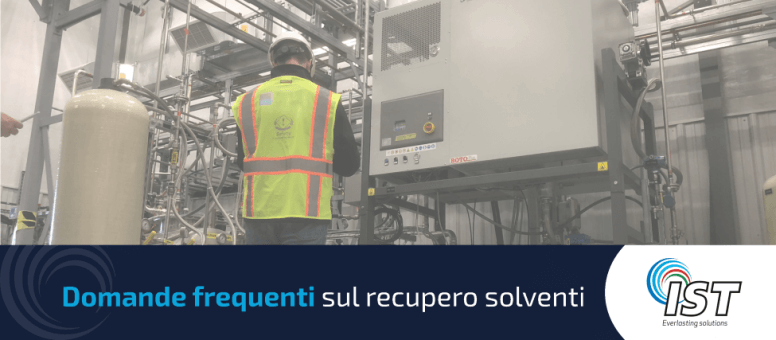
What is solvent distillation and how does it work?
Solvent distillation is a separation process used to purify or remove contaminants from industrial solvents. It is based on the difference in boiling points between the components of the mixture. The solvent is heated until it evaporates and then condensed into a purified liquid, thus separating the impurities that remain in the distillation residue.
What are the advantages of distillation for solvent recovery?
- Cost reduction: recovering and reusing solvents reduces the purchase of new material.
- Environmental sustainability: minimizes the release of chemicals into the environment and reduces hazardous waste.
- Regulatory Compliance: Helps meet regulations on chemical emissions, hazardous materials storage, and waste management.
- Product purity: fractional and azeotropic distillation allow for the production of high purity solvents.
- Greater autonomy: by managing the process independently, you are not tied to suppliers and disposal companies.
What is the typical return on investment (ROI) of a distillation system?
The ROI for a distillation system depends on various factors, such as the volume of solvent used, the cost of virgin solvent, disposal costs, and local regulations. However, in many industrial applications, solvent recovery can reduce operating costs by up to 70–80%, with ROI achieved in 6–18 months.
What are the main solvents recovered through distillation?
Solvents commonly used in the chemical, pharmaceutical, electronics, ink, and paint industries can be distilled.
Among the main solvents recovered we find:
| Acetone | Ethyl Acetate |
| Methanol | Xylene |
| Ethanol | Styrene |
| Toluene | Kerosene |
| N-Methyl-2-Pyrrolidone (NMP) | Isopropyl Alcohol |
| Dichloromethane | Methoxypropanol |
| Methyl ethyl ketone (MEK) | Butyl Acetate |
What are distillation residues and how are they managed?
Distillation residues are the impurities and contaminants that remain after the solvent has been recovered. These residues may include resins, polymers, metals, or non-volatile chemical compounds. Residue management depends on their composition: they can be treated as hazardous waste or, in some cases, further processed to recover useful substances.
What regulations govern solvent recovery?
Regulations vary by region, but generally include:
- EPA in the United States: Regulates hazardous waste management and VOC (volatile organic compound) emissions.
- REACH in the EU: regulates the use of hazardous solvents and promotes the use of safe technologies.
- Local agencies: May have additional requirements for solvent recovery and disposal, particularly for facilities with high emissions or using specific chemicals.
What are the differences between solvent recovery and regeneration?
- Recovery: the solvent is separated from impurities and made reusable in the same industrial process.
- Regeneration: the solvent is purified to return it to a state almost identical to the original, suitable for more sophisticated uses.
What are the main types of distillation used for solvent recovery?
- Simple distillation: Separates two components with significantly different boiling points.
- Fractional distillation: ideal for mixtures with close boiling points.
- Azeotropic distillation: Used to break azeotropes (mixtures that behave as if they have a single boiling point).
- Vacuum distillation: Used for temperature-sensitive solvents, it reduces the boiling point by lowering the pressure.
Is it possible to distill solvent mixtures?
If the boiling temperatures of the various solvents are similar, a simple distillation can be performed, with just one heating temperature.
If, however, the mixture is composed of solvents with very different boiling points, it is still possible to recycle the solvents by setting up distillation cycles with different heating intervals depending on the boiling point, to evaporate the solvents sequentially from the lowest boiling point to the highest boiling point.
How many times can a solvent be distilled?
Distillation is a physical, not chemical, process. During distillation, the liquid is heated to its boiling point; the vapors created by boiling are condensed and returned to a liquid state. No chemical reaction occurs between the substances involved: it is simply a change of state (liquid → vapor → liquid) that allows separation without changing the chemical composition of the individual substances.
Therefore a solvent can be distilled practically indefinitely.
What to consider before installing a solvent distillation system?
- Volume of solvent treated: to choose the size of the distiller and the process mode.
- Chemical composition of the mixture: to determine the most suitable type of distillation.
- Purity requirements: to select the most suitable method.
- Management and maintenance costs: to ensure a positive ROI.
- Local regulations: To ensure that the facility meets all environmental and safety requirements.
What parameters influence distillation efficiency?
- Temperature and pressure: Properly adjusting the temperature and pressure is crucial to optimizing the process.
- Type of heating: with thermal oil or high-efficiency fluids rather than with steam or hot water.
- Type of distillation column: The use of packed columns can affect the quality and speed of separation.
- Condensing system: air-cooled or chilled water-cooled.
- Composition of the mixture: The presence of azeotropes or solvents with similar boiling points requires fractional distillation or the addition of azeotropic agents.
- Homogeneity of the spent solvent: treating a product with the same concentration of solvent and solute guarantees repeatable results and therefore process optimization.
How is the recovery of solvents with high boiling temperatures or thermal sensitivity managed?
For solvents with high boiling points or heat sensitivity, vacuum distillation is used. This approach reduces the internal pressure of the system, thus lowering the solvent’s boiling point and preventing thermal degradation.
What technologies are used to optimize the distillation process?
- Packed or tray columns: to increase the purity of the distillate.
- Continuous mixing: to avoid phase separation.
- Automatic control: Automatic monitoring and control systems to continuously adjust the process.