
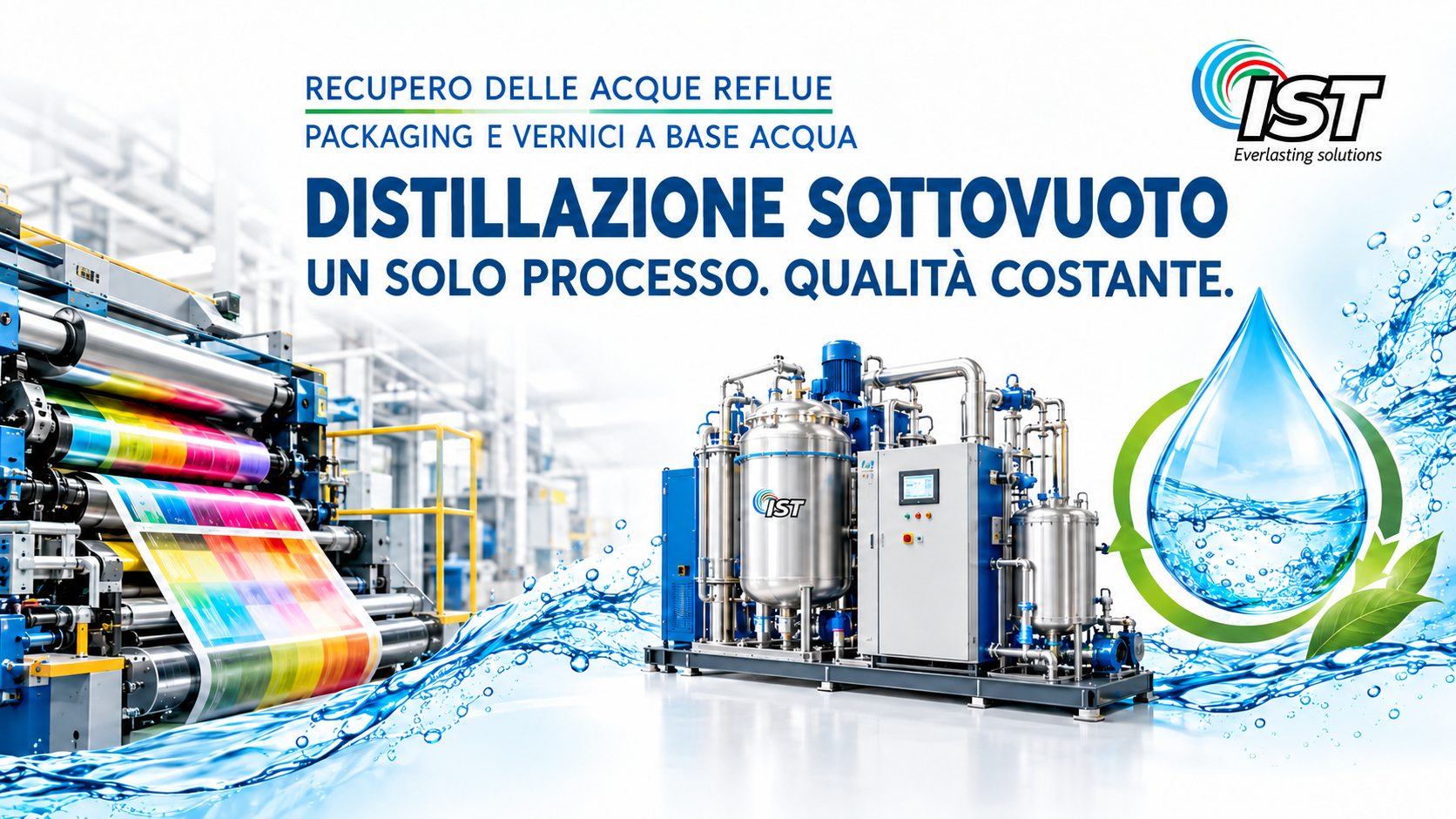
Why Vacuum Distillation Outperforms Flocculation
In the packaging sector, particularly in flexographic and gravure printing with water-based inks, as well as in water-based paint production, washing presses, tanks, cylinders, doctor blades and piping generates significant quantities of wastewater every day, loaded with pigments, resins, binders, surfactants, glycols and additives.
Recovering this water has now become both an economic and environmental necessity.
But the technology chosen determines whether the recovered water can actually be reused in the production process or whether, cycle after cycle, it becomes a new source of problems.
🔴 01 — THE STRUCTURAL LIMITATION OF FLOCCULATION
To separate the dirt, salt is added to the water.
Physico-chemical flocculation separates suspended and colloidal fractions by adding coagulants, typically aluminium or iron salts such as polyaluminium chloride, aluminium sulphate or ferric chloride.
Polyelectrolytes and, often, reagents for pH correction are also added.
The critical point is precisely this:
TO CLEAN THE WATER, SALTS ARE ADDED.
Part of the reagents precipitates with the sludge, while another part remains dissolved in the form of chlorides, sulphates and metal ions.
The result is an increase in conductivity and total dissolved solids.
If the treated water is reused for washing, the phenomenon accumulates: with each cycle, the wastewater becomes increasingly enriched with salts until the water is no longer suitable for its intended use.
In water-based processes, this is not a minor detail.Acrylic emulsions and pigmented systems are sensitive to electrolytes.
Saline wash water can therefore:
- contaminate the next product;
- promote dispersion instability;
- alter viscosity and performance;
- create deposits;
- increase corrosion of metal parts of the equipment.
🟠 02 — INCOMPLETE PURIFICATION
The problem is not only what you can see.
Flocculation is effective on suspended and colloidal fractions, but has little or no effect on dissolved organic matter.
Glycols, coalescents, surfactants, amines and soluble additives remain in the water.
Residual COD therefore often remains high, with possible consequences such as:
- odours;
- foaming;
- bacterial growth in storage tanks.
This is compounded by wastewater variability.
Changes in colour, formulation and resin require continuous adjustment of dosages, jar tests and skilled personnel.
The quality of the outlet water therefore depends more on day-to-day management than on the technology.
🟡 03 — TO REACH DISTILLATE QUALITY, ADDITIONAL PROCESSES ARE REQUIRED
To obtain water from flocculation that is comparable to distilled water, additional polishing stages are required:
SAND FILTRATION → ACTIVATED CARBON → ULTRAFILTRATION → REVERSE OSMOSIS
The objective is also to remove the salts introduced by the treatment itself.
This creates a paradox:
FIRST, SALT IS ADDED TO FLOCCULATE; THEN A MEMBRANE PROCESS IS INSTALLED TO REMOVE IT.
The treatment chain therefore becomes long and costly, with many points requiring control and increasing the potential for problems and failures.
AND WHAT ABOUT REVERSE OSMOSIS?
Reverse osmosis also brings additional critical issues:
- fouling of membranes by residual polymers and pigments;
- periodic chemical cleaning;
- membrane replacement;
- production of a saline concentrate that must be managed and disposed of.
More processes. More maintenance. More variables. More costs.
🟤 04 — SLUDGE: MORE VOLUME, MORE COSTS
Flocculation generates voluminous, water-rich sludge, to which the mass of the added reagents must also be added.
Without intensive dewatering, using a filter press or similar systems, disposal costs remain high.
This means additional investment, additional equipment and additional management operations.
THE PROBLEM DOES NOT DISAPPEAR: IT SIMPLY CHANGES FORM.
🟢 05 — VACUUM DISTILLATION
ONE PROCESS. CONSISTENT QUALITY.
Vacuum distillation works through physical separation.
By reducing the pressure, water can evaporate at low temperature.
EVAPORATION → CONDENSATION → DISTILLATE
During the process, pigments, resins, salts and most dissolved substances remain in the concentrate.
The result is high-quality recovered water that can be returned to the washing cycle.
🟢 NO CHEMICAL REAGENTS ADDED
The water is not loaded with salts through the treatment process.
In some cases, small doses of antifoam may be required depending on the type of wastewater; when used, it remains in the concentrated residue.
NO SALT ADDED. NO ACCUMULATION CAUSED BY THE TREATMENT.
🟢 HIGH-QUALITY DISTILLATE
Evaporation followed by condensation produces a distillate characterised by:
low conductivity + very low solids content
without the need for reverse osmosis or further polishing stages.
🟢 QUALITY INDEPENDENT OF THE INLET WASTEWATER
Do colour, formulation or resin change?
The process does not require the same continuous dosage adjustments typical of flocculation.
The physical process remains stable, repeatable and automatable.
🟢 MAXIMUM WASTE REDUCTION
The initial wastewater is separated into:
RECOVERED WATER + CONCENTRATED RESIDUE
The residue represents a small fraction of the initial volume, reducing disposal costs and bringing the plant closer to the goal of zero discharge.
🟢 SIMPLE AND AUTOMATABLE OPERATION
Fewer reagents.
Fewer variables.
Less operator intervention.
Fewer opportunities for error.
Automation makes it possible to control the process in a simple and repeatable way.
🔵 06 — WITH OR WITHOUT A HEAT PUMP?
Vacuum distillation is available in different configurations.
Heat-pump solutions recover the heat of condensation to feed the evaporation process again.
THE HEAT IS RECOVERED AND REUSED.
This significantly reduces energy consumption and makes the technology competitive also in terms of operating costs.
⚫ FLOCCULATION OR VACUUM DISTILLATION?
| FLOCCULATION | VACUUM DISTILLATION |
| Adds chemical reagents | Physical separation |
| Adds salts to the water | No salt added |
| Generates sludge | Generates concentrated residue |
| Requires dosage control | Automated process |
| Leaves part of the dissolved organic load | Separates water from concentrated substances |
| May require further treatment | Distillate obtained in the process |
| May require reverse osmosis | Does not require the same polishing route |
| More treatment stages | More direct process |
| Greater sludge management | Strong reduction in disposal volume |
🟢 THE CONCLUSION
RECOVERY DOES NOT SIMPLY MEAN PURIFICATION.
In packaging and water-based paint production, the objective is not simply to treat wastewater.
The objective is to recover clean, stable water that can be reused in the production process.
Flocculation introduces salts that accumulate with each reuse and, to approach distillate quality, requires additional processes such as reverse osmosis, increasing costs, complexity and management requirements.
Vacuum distillation, based on low-temperature evaporation followed by condensation, instead enables water recovery through a physical process, without added chemicals, with consistent quality over time and a significant reduction in the residue to be disposed of.
ONE PROCESS.
RECOVERED WATER.
LESS WASTE.
MORE CONTROL.
For water-based wastewater recovery, vacuum distillation is the most effective and sustainable solution.